AC Capacitor Replacement Cost: The Cheap Part That Protects Your Compressor
Replacing an AC capacitor costs $100–$250 in 2026, including the part and labour — one of the cheapest repairs on the list. Left alone, a weak capacitor makes the compressor strain on every start, and a burnt-out compressor costs $1,300–$2,800 to replace. That is the whole reason this small part is worth attention.
| Item | Typical installed cost |
|---|---|
| Capacitor replacement | $100 – $250 |
| Diagnostic / service call | $75 – $200 |
| Contactor replacement (often fails alongside) | $120 – $300 |
| Compressor replacement | $1,300 – $2,800 |
| Replacement central AC unit | $3,900 – $7,900 |
What a capacitor does
The capacitor is a small cylinder inside your outdoor condenser unit. It stores an electrical charge and releases it to give the compressor and fan motors the surge they need to start turning.
It is also a wear item. Heat, age and voltage fluctuations degrade capacitors long before the rest of the system is due for replacement — typically every 5 to 10 years, against the 12 to 18 years a central air conditioner should last. The compressor, by contrast, is not designed to be replaced at all during normal service life.
How a cheap part damages an expensive one
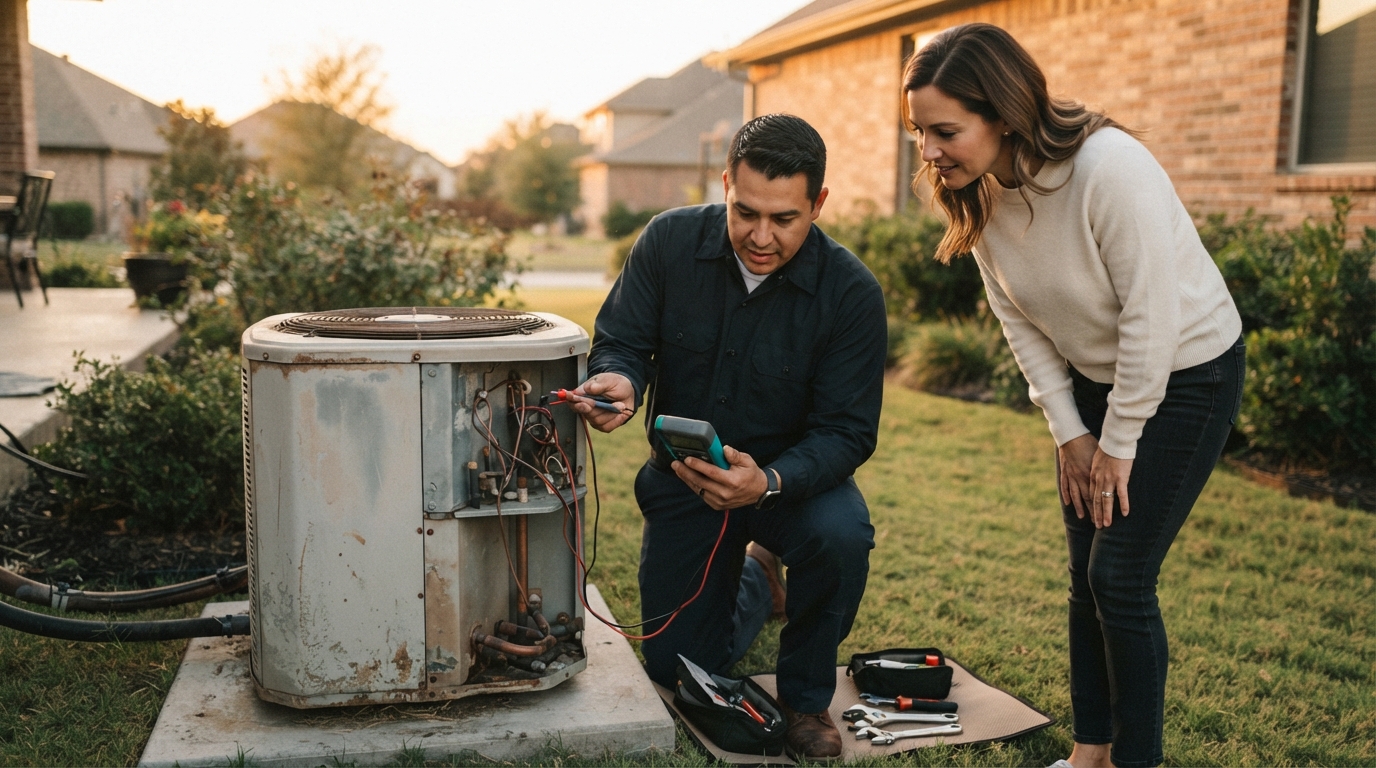
A failing capacitor cannot deliver the full starting surge. The compressor motor still tries to start, but it strains — drawing more current than it should, running hotter, and cycling on and off more often than a healthy system.
Repeat that over enough starts and the motor windings overheat and break down. At that point you are no longer buying a capacitor. You are buying a compressor, and on an older system many contractors will recommend replacing the outdoor unit outright rather than fitting a new compressor to ageing components around it.
What it costs, and what it prevents
These are the same figures we publish in our AC repair cost guide — the point of this page is the gap between the two rows, not new numbers.
Signs a capacitor is going
Capacitors rarely fail without warning. The system keeps running, just less willingly, and most people put the symptoms down to age:
- A hum before it starts. The unit buzzes for a few seconds before the compressor kicks in, or hums without ever starting.
- The fan runs but the compressor does not. Air moves, but nothing gets cold.
- Short cycling. The system switches on and off more often than it used to.
- It struggles on the hottest days. Which is also when the compressor is already under most strain.
- A visibly swollen or leaking capacitor. Bulging tops and oily residue are terminal — though plenty of failing capacitors look perfectly normal, which is why testing matters.
Why you should not do this one yourself
Capacitors store a dangerous electrical charge after the power is switched off, and can discharge through you if handled without shorting them out first. This is the repair where the saved labour is least worth the risk.
There is a practical reason too: a capacitor that fails again within months usually means something else — a hard-starting compressor, low voltage, a failing contactor — is destroying it. A technician measures capacitance against the rating stamped on the part and looks for the underlying cause. Swapping the part alone treats the symptom.
When the compressor has already gone
If the damage is done, the decision is the same one covered in our AC repair cost guide: compare the repair against a new unit rather than against nothing.
A compressor still inside its manufacturer parts warranty changes the maths considerably — you may owe only labour. Outside warranty, on a system past 10 years, a $1,300–$2,800 compressor against a $3,900–$7,900 replacement condenser usually points one way. Our component lifespan guide has the age-based formula.
Keeping it on the cheap side
- Book an annual service before cooling season, not during it.
- Ask specifically for the capacitor to be tested with a meter, not inspected by eye. Ask what reading it gave against its rated value — a capacitor measurably below its rating is failing even if it looks fine.
- Act on a hum or a slow start the same week. This is the entire difference between the two numbers on this page.
- Get the reading in writing on the service report, so you can see it drift year on year.
Ask for the capacitor's measured capacitance on every annual service, written on the report. A part rated 45 μF reading 38 μF is failing even though it still works — and that is the moment a $150 repair is the whole story rather than the opening chapter.
Frequently asked questions
How much does an AC capacitor cost to replace?
$100 to $250 in 2026, including the part and labour. The capacitor itself is inexpensive; most of the bill is the diagnostic visit and the trip.
Can a bad capacitor really damage the compressor?
Yes. A weak capacitor leaves the compressor motor drawing excess current on every start attempt, and repeated overheating from that strain is a recognised cause of premature compressor failure.
How do I know whether it is the capacitor or the compressor?
A failing capacitor usually shows as a hum before starting, a fan that runs while nothing cools, or short cycling. A failed compressor typically means the outdoor unit will not run at all or trips the breaker. A technician can tell you which in one diagnostic visit.
How long should an AC capacitor last?
Usually 5 to 10 years, though heat shortens that — capacitors in hot climates fail sooner. Central air conditioners last 12 to 18 years, so expect to replace a capacitor at least once during a system's life.
Can I replace an AC capacitor myself?
We would not recommend it. Capacitors hold a dangerous charge after the power is off and must be discharged safely before handling. A repeat failure also usually points to a separate underlying fault that needs diagnosing.
My capacitor failed again within a year — why?
A capacitor failing that fast is normally a symptom, not the fault. A hard-starting compressor, a failing contactor, low supply voltage or sustained high heat will all destroy replacements. Ask the technician what they found beyond the part itself.
Ready to get quotes?
Find rated HVAC contractors near you and compare a few before you commit.
Find a local pro →