How Long Does Each HVAC Component Last? 2026 Lifespan & Cost Guide
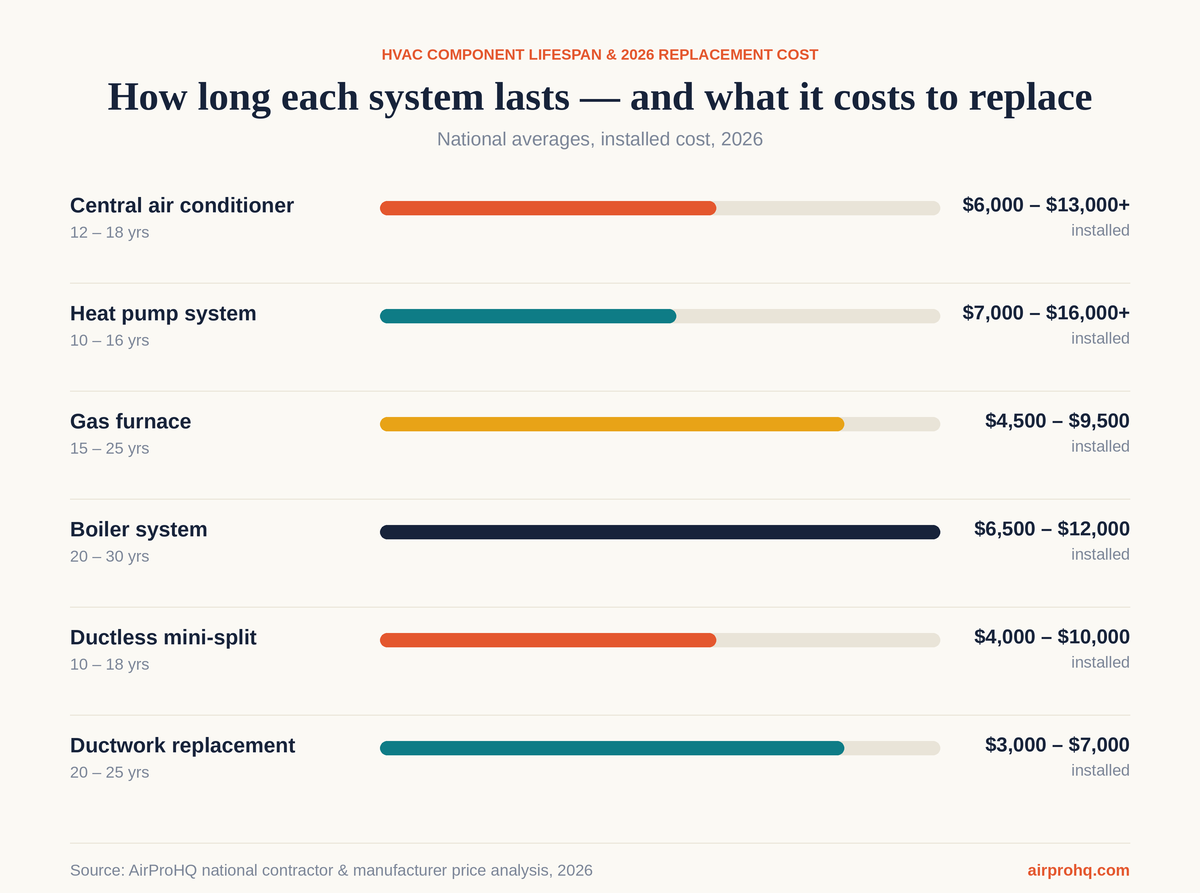
Central air conditioners last 12–18 years, heat pumps 10–16 years, gas furnaces 15–25 years, and boilers 20–30 years. 2026 replacement costs run from about $3,000 for ductwork up to $16,000+ for a heat pump system, driven partly by the ongoing shift to A2L refrigerants raising equipment costs 15–30% over the last three years.
Compare the expected service window of major systems against current national average installation costs.
Longevity is highly sensitive to annual maintenance and coastal salt-air exposure.
Year-round use (heating and cooling) wears components faster than AC-only systems.
Simpler mechanical parts let furnaces often outlast cooling-specific components.
| Component | Expected lifespan | Replacement cost (installed) |
|---|---|---|
| Central AC unit | 12 – 18 years | $6,000 – $13,000+ |
| Heat pump (electric) | 10 – 16 years | $7,000 – $16,000+ |
| Gas furnace | 15 – 25 years | $4,500 – $9,500 |
| Boiler system | 20 – 30 years | $6,500 – $12,000 |
| Ductless mini-split (multi-zone) | 10 – 18 years | $4,000 – $10,000 |
| Ductwork replacement | 20 – 25 years | $3,000 – $7,000 |
| Smart thermostat | 8 – 12 years | $250 – $600 |
Why HVAC economics changed in 2026
If you have not shopped for a new HVAC system since 2020, you are entering a different market. Two factors have shifted the useful service window and replacement costs for U.S. homeowners.
The A2L refrigerant transition
The EPA's phase-down of R-410A refrigerant has reached its most consequential stage. New systems must now use A2L refrigerants such as R-454B or R-32, which are more environmentally friendly but run at different pressures and safety standards than older equipment.
- Compatibility: you cannot simply recharge an old system with a new refrigerant type — if your outdoor unit fails, the indoor evaporator coil often needs replacing too, for compatibility.
- Cost impact: redesigning equipment for A2L sensors and safety mitigations has pushed equipment costs up 15–30% over the last three years.
The "climate tax" on longevity
National lifespan averages are often optimistic. Data from our directory of HVAC contractors in Texas and other high-heat regions shows systems in demand markets like Houston, Phoenix or Miami often reach terminal failure 3–5 years earlier than the national average, due to compressor fatigue from near-constant summer cycling.
Additional decision factors
- The "three strikes" rule: three or more major repairs (capacitor, blower motor, refrigerant leak) in three years means the system is in a repair spiral.
- The 50% rule: if a single repair costs more than half the price of a new, warrantied system, replacement is the logical choice.
- Efficiency gains: moving from an old 10 SEER unit to a 2026-standard 17 SEER2 system can cut monthly energy bills 30–50%, often paying back the cost gap within five years.
How we source these 2026 estimates
AirProHQ draws on three sources to keep this guide current: anonymized data from our network of verified HVAC contractors across the U.S.; wholesale equipment price tracking from major manufacturers as they roll out A2L-compliant product lines; and regional labor-rate surveys, since replacing a unit in a market like League City, TX involves different overhead than a rural market.
Regional lifespan adjusters
Climate is the biggest single factor in how long a system actually lasts. Use these adjustments against the national averages above:
- Coastal areas (within 5 miles of the ocean): subtract roughly 25% from expected lifespan — salt air accelerates coil corrosion. Relevant for Galveston and similar coastal markets.
- Desert / high-heat zones: subtract roughly 15% due to high-cycle fatigue during 100°F+ summers.
- Temperate climates: add 10–15% if the system runs only 3–4 months a year.
2026 is projected to be a record year for HVAC replacements — roughly 3.5 million units — as systems installed during the 2005–2007 housing boom reach the end of their typical 20-year service life.
If the result is over $7,000, replacement is typically the better value — the older the system, the less a given repair bill is worth spending.
Worked example: a 12-year-old AC needing an $800 repair scores 12 × $800 = $9,600 — over the threshold, so replacement wins. The same $800 repair on a 4-year-old unit scores just $3,200 — well worth fixing.
Frequently asked questions
Why is HVAC replacement so much more expensive in 2026?
The A2L refrigerant transition required a redesign of system components, and a persistent shortage of skilled technicians has pushed labor rates up roughly 20% since 2023.
Can I still get R-410A refrigerant for my 10-year-old system?
Yes, but it is getting expensive as the EPA phases down supply — a simple recharge can now cost $800–$1,500, which makes standard AC repair costs much harder to justify on an aging system.
Is it worth replacing my furnace when I replace my AC?
Usually, yes. A matched system ensures both units are optimized for the same refrigerant and SEER2 efficiency standard, and typically saves $1,500–$2,500 in labor versus doing them separately.
How do I know if my contractor is giving me a fair 2026 price?
Check independent ratings and get multiple quotes. Our guide to hiring an HVAC contractor covers the exact questions to ask and how to verify you are getting a current-market price.
Ready to get quotes?
Find rated HVAC contractors near you and compare a few before you commit.
Find a local pro →