2026 HVAC Market Snapshot: What's Really Driving Costs Up
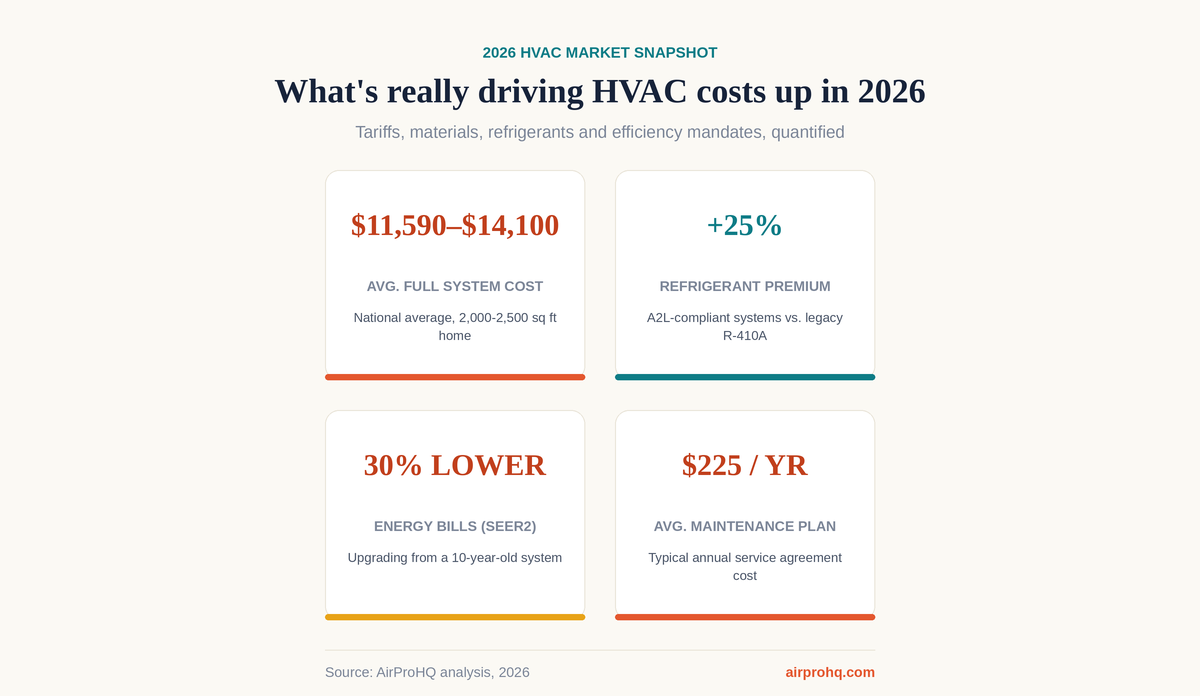
2026 market snapshot: what's pushing HVAC costs higher, and where the savings are.
A full HVAC system now averages $11,590–$14,100 nationally in 2026, up sharply from a few years ago. Three forces are driving it: the mandatory shift to A2L refrigerants (a 20–30% equipment premium), stricter SEER2 efficiency rules, and volatile material costs — including a 145% tariff on certain imported components and 10–15% annual inflation in specialized labor. Upgrading to a SEER2-compliant system can offset some of this with roughly 30% lower energy bills.
2026 HVAC market snapshot
If you haven't replaced an HVAC system since 2020, current pricing can be a shock. Several forces have converged at once to push the market to these levels.
National average for a 2,000–2,500 sq ft home.
A2L-compliant systems vs. legacy R-410A equipment.
Typical savings upgrading from a 10-year-old system.
Typical cost of an annual service agreement.
Three forces pushing prices up
The A2L refrigerant transition. As of January 1, 2026, newly manufactured residential AC systems must use A2L refrigerants such as R-454B or R-32. These have roughly 78% lower global warming potential than outgoing R-410A, but being mildly flammable, they require safety sensors, redesigned compressors and specialized technician training — a 20–30% price premium over legacy units. See our A2L refrigerant and tax credit guide for the full breakdown, including how federal incentives can offset it.
SEER2 efficiency mandates. The current efficiency standard, SEER2, uses a more rigorous test that mirrors real-world duct pressure. Units built to this standard cost more to manufacture, but can cut monthly cooling bills by roughly 30% versus a 10-year-old system.
Material inflation and tariffs. Copper, steel and aluminum prices remain volatile, and a 145% tariff on specific imported components — combined with 10–15% annual inflation in specialized HVAC labor — has pushed even a simple, single-component job into the $5,000+ range.
One item missing from most cost guides: whole-home dehumidifiers
Beyond the core system, more 2026 installs are pairing in a whole-home dehumidifier — typically $2,100–$4,500 installed, with an 8–12 year lifespan. It is a smaller line item, but worth budgeting for if humidity control has been a persistent issue in your home.
Repair or replace?
We cover the full repair-vs-replace formula, with a worked example, in our HVAC component lifespan guide — worth reading before you commit to either option. As a quick gut-check: a unit over 12 years old, needing a compressor or coil, or still running on discontinued R-22 refrigerant, usually favors replacement. A unit under 8 years old with a simple electrical fault (capacitor, contactor) and a history of annual maintenance usually favors repair.
Frequently asked questions
Why is my quote so much higher than my neighbor's was a few years ago?
Costs have spiked from the combination of the 2026 EPA refrigerant mandate, a 145% tariff on specific imported materials, and the added complexity of SEER2-compliant hardware — not any one factor alone.
Are there incentives for switching to a heat pump?
Yes — many homeowners qualify for federal tax credits and utility rebates that can offset $2,000 or more of the installation cost. See our tax credits and rebates guide for the current 2026 amounts and eligibility.
Is a home maintenance agreement worth the $225 a year?
Usually, yes. Annual maintenance catches small issues (like a failing capacitor) before they become expensive repairs, and most manufacturer warranties require documented annual service to stay valid.
Ready to get quotes?
Find rated HVAC contractors near you and compare a few before you commit.
Find a local pro →